Yes, you can buy off-plan in Dubai from abroad without being a resident: to register the purchase, the DLD asks non-residents for a copy of a valid passport. You choose the project, sign the contract with the developer and pay the down payment and the 4% DLD fee. The developer registers the purchase with the DLD within 90 days and you pay the rest in stages into the project’s escrow account, which protects your money. At handover you inspect the property, pay the balance and receive the title deed.
In this guide15 sections
- Can a foreigner buy property in Dubai?
- The purchase, step by step
- What does it cost on top of the price?
- Payment plans: what you pay at each stage
- How do you pay from abroad?
- Buying without travelling to Dubai
- Is your money protected? Escrow and RERA
- What if construction is delayed or the project is cancelled?
- Can you sell before handover?
- Golden Visa: 10-year residency from AED 2 million
- Taxes: what you pay in Dubai and what you declare at home
- Buying from the UK or the US: what changes
- Bank account and costs after handover
- What we do for you
- Frequently asked questions
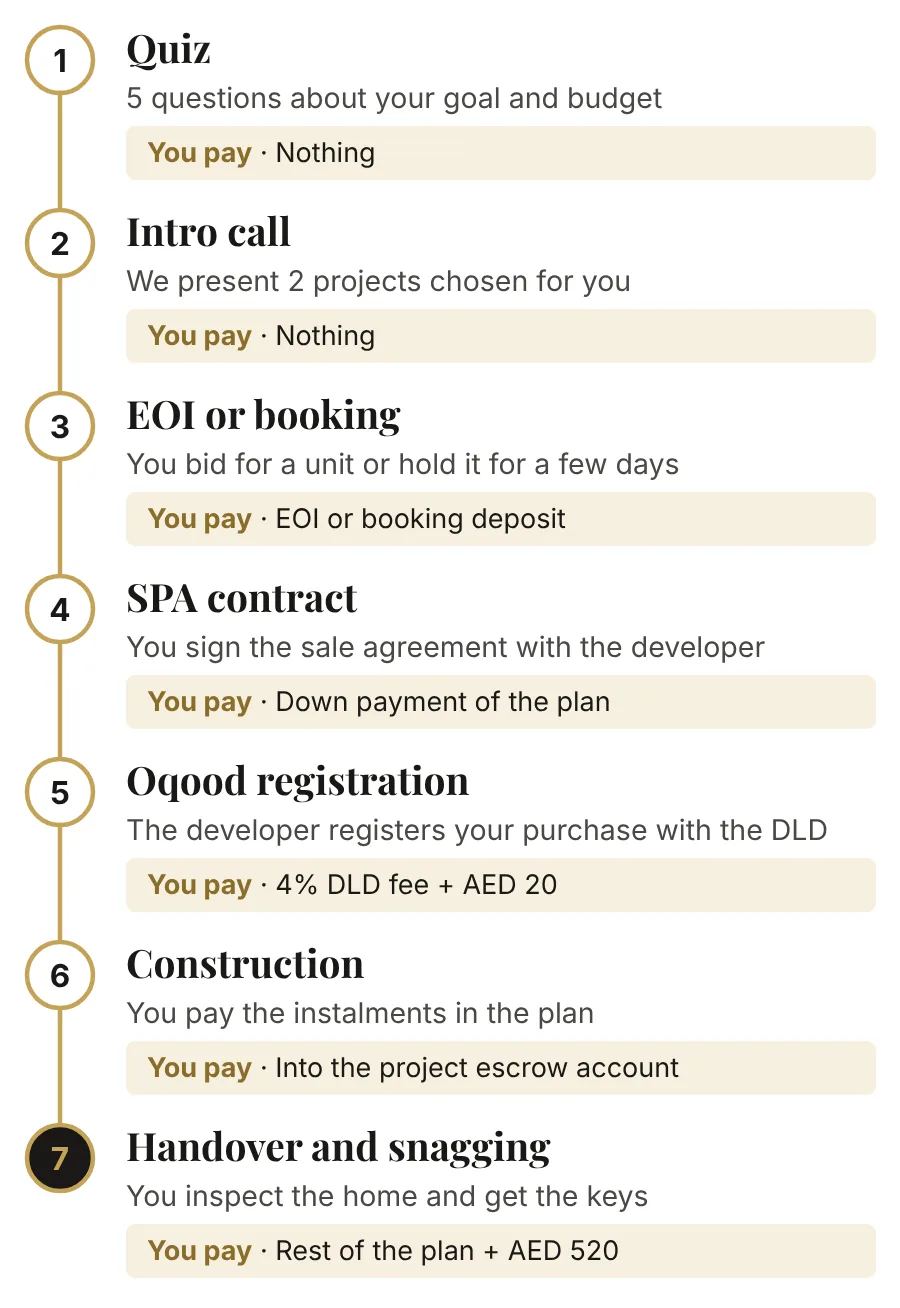
| Step | What happens | What you pay |
|---|---|---|
| 1. Quiz | You tell us your goal, your budget and when you want to invest | Nothing |
| 2. Intro call | We present 2 projects chosen from your answers | Nothing |
| 3. EOI or booking | You bid for a unit at launch or hold a specific one | The EOI or deposit, credited to the price if you buy |
| 4. SPA contract | You sign the sale agreement with the developer | The plan’s down payment, often 10% or 20% |
| 5. Oqood registration | The developer registers the sale with the DLD within 90 days | 4% DLD fee + AED 20 |
| 6. Construction | You pay the plan instalments | Into the project escrow account |
| 7. Handover | You inspect the property, pay the balance and get the title deed | Rest of the plan + AED 520 |
Can a foreigner buy property in Dubai?
Yes. Dubai Law No. 7 of 2006 allows foreigners to own property freehold, with no time limit, in the areas designated for it.
You do not need residency or a visa. To register the purchase, the DLD, Dubai’s land and property department, asks for the contract and, for non-residents, a copy of a valid passport. You can also buy through a company, with extra documents such as the trade licence and the memorandum of association translated into Arabic.
Buying off-plan means buying a home that is still being built, directly from the developer. You do not pay it all at once: you pay in stages until handover, following a payment plan set out in the contract.
The purchase, step by step
This is what an off-plan purchase looks like when you do it with us, from first contact to getting the keys.
1. The quiz
Five quick questions about your goal, your budget and when you want to invest. That tells us whether you want income, capital growth or a home to use yourself, and how much you can put down at the start without stretching.
2. The intro call
We get to know each other and present 2 projects chosen from your answers. We only work with developers and projects we have already selected, so you do not get a catalogue of hundreds of listings, just two options picked for you. You decide whether to go ahead.
3. EOI or booking
For high-demand launches, many developers first ask for an EOI, an expression of interest. It is a payment to bid for a unit when sales open. It does not secure one and is usually refunded if you do not go on to book, but each developer sets its own terms.
Once you have chosen the unit, you sign the booking form and pay a deposit. The booking holds that unit for a few days and the amount is credited to the price. Bear in mind that the deposit is usually not refunded if you walk away.
4. The SPA contract
The SPA is the sale and purchase agreement with the developer. It sets the price, the unit, the payment plan, the expected handover date, penalties and what happens if either side defaults. When you sign it you pay the plan’s down payment. Read it in full before signing, especially the clauses on delays and missed payments.
5. Oqood registration
Oqood is the DLD’s interim register for homes under construction. The developer registers your purchase within 90 days of signing and the certificate is emailed to you. This is when the 4% DLD fee and AED 20 in fees are paid. From then on your purchase is on Dubai’s official register.
6. Construction and the payment plan
While the building goes up, you pay the instalments in your plan, by date or by construction milestone, always into the project’s escrow account. If an instalment is tied to construction progress, the DLD recognises your right to know the completion percentage before paying it. You can check it yourself in the Dubai REST app.
7. Handover and snagging
When construction is finished, the developer calls you for handover. Before accepting it, it is worth doing a snagging inspection to find defects, from finishes to installations. You make a list and the developer must fix them. Then you pay what is left of the plan, the DLD charges AED 520 for the title deed, the map and its fees, and your title deed is issued. From there you can rent it out or move in.
What does it cost on top of the price?
The official costs of an off-plan purchase are few and fixed. On top of them come the developer’s own charges and, where applicable, the agency’s.
- DLD fee: 4% of the price. The rules split it equally between buyer and seller unless agreed otherwise, but to avoid surprises, plan on paying all of it. Some developers pay it for you as an incentive. Your contract decides.
- Oqood registration: AED 20. Two AED 10 fees the DLD adds when the sale is registered.
- Handover: AED 520. AED 250 for the title deed, AED 250 for the map and AED 20 in fees.
- Developer charges. Some developers charge an admin fee for handling the contract or the registration. It is not a DLD fee, each developer sets it and VAT may apply.
- Agency commission. Set by agreement. On an off-plan purchase, who pays it depends on the arrangement with the developer. Always get it in writing before booking.
For an AED 1,000,000 home, if you pay the full 4%, the official costs add up to AED 40,540, about €9,800 or $11,000. Try other prices in the off-plan calculator and see the details in our costs guide.
Payment plans: what you pay at each stage
Each project has its own payment plan. The two numbers show how much you pay before handover and how much when you get the keys. A 60/40 means 60% up to handover, down payment included, and 40% at the end. In our sample of 60 launches up to AED 700,000 in October 2026, the most common plans were 50/50, 20/80, 60/40 and 30/70.
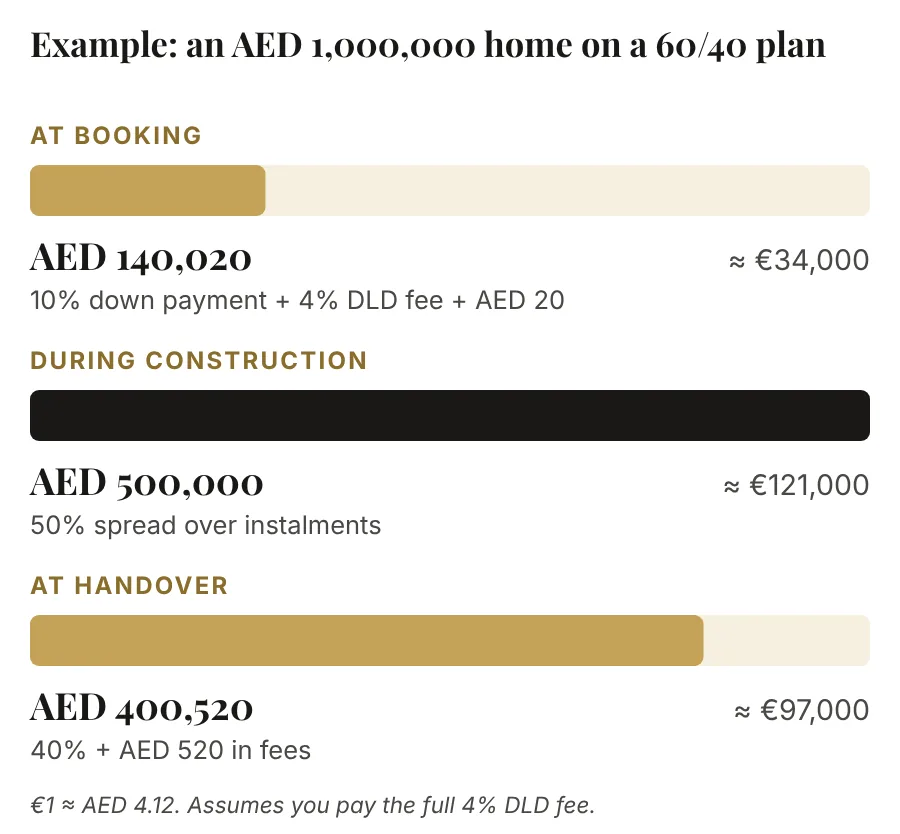
A plan weighted towards construction leaves less to pay at handover. With a 20/80 or 30/70 you pay little while the building goes up, but you will need 70% or 80% ready on the handover date, from savings, the sale of another asset or a mortgage for non-residents. A mortgage depends on the bank approving it at that point, so have a plan B.
Post-handover plans
On a post-handover plan, part of the price is paid after you receive the property, for example over 2 or 3 years. That lets you rent it out while you finish paying. They usually require post-dated cheques or another guarantee for those instalments, and it is worth knowing what happens if you are late on one.
There are more examples in our off-plan payment plans guide.
How do you pay from abroad?
Each developer sets its own methods, but this is the usual picture.
- International transfer. The norm for the down payment, instalments and handover. It is sent in dirhams to the project escrow account, with your name and unit number in the reference. Ask your bank for the exchange rate and fees before sending: a 0.5% difference is €500 on a €100,000 payment.
- Cheques. Widely used in the UAE, above all post-dated cheques on post-handover plans. You need a UAE bank chequebook, although some developers accept alternatives for non-residents.
- Card. Some developers accept cards for the EOI and the booking. Check your card limit and foreign currency fees first.
- Crypto. Only some developers accept it, almost always through an intermediary licensed by VARA, Dubai’s virtual assets regulator, which converts it to dirhams. You will be asked for the source of funds and the transaction is always reported to the UAE Financial Intelligence Unit.
- Cash. Very limited. Some developers do not accept it for instalments and, from AED 55,000, the agency must report the transaction. We do not recommend it.
Your bank may ask for the contract or the payment letter to support a large transfer. That is normal, so have them as PDFs before sending. Each method, including the EOI, is covered in detail in our guide to payment methods and EOIs.
Buying without travelling to Dubai
Much of the purchase can be done remotely. Payments go by transfer, the developer handles the Oqood registration on its portal and the certificate is emailed to you.
If a step requires you in person, you can give a trusted person a power of attorney. If you sign it outside the UAE, the DLD accepts it once it is ratified by the notary public and the Ministry of Foreign Affairs of the country where it was signed, the UAE embassy in that country and the UAE Ministry of Foreign Affairs.
An apostille is not enough on its own. The UAE is not a party to the Hague Apostille Convention, so the power of attorney needs that chain of legalisations even if your country has signed it.
According to the DLD, a power of attorney to buy is valid for five years from notarisation, and one to sell, mortgage or gift for two years. Your attorney can only do what the document states, so it is best drafted for that specific transaction.
Is your money protected? Escrow and RERA
Dubai Law No. 8 of 2007 requires every developer selling off-plan to open an escrow account for each project with an approved bank. What buyers pay goes into that account, not into the developer’s pocket. The bank only releases money as construction reaches each milestone, and 5% is held for one year after completion to cover defects.
Above that sits RERA, Dubai’s real estate regulator, part of the DLD. It registers developers and projects, audits escrow accounts, approves service charges and authorises ads. An off-plan sale made before all approvals are in place is void.
You can check this yourself. The Dubai REST app shows whether the project is registered, its completion percentage and its escrow account number. Only pay instalments into that account, never into anyone’s personal account. Our guide to checking an off-plan project is safe shows you how.
What if construction is delayed or the project is cancelled?
The SPA sets the expected handover date and the penalties, and that is where you find what you can claim if the developer does not deliver on time. These terms vary from contract to contract, so that clause deserves a careful read before you sign.
Meanwhile, your money stays in the escrow account and is only released as construction progresses. If work never starts for reasons beyond the developer’s control, or if RERA cancels the project, the developer must refund everything you paid. On cancellation, the account passes to the DLD’s liquidation department, which asks the developer to refund buyers within 60 days. If it does not, the matter goes to court.
If you are the one who stops paying
The developer must notify the DLD, which gives you 30 days to catch up and tries to reach an agreement. If you still do not pay, what the developer can do depends on construction progress. With work started and below 60%, cancel the contract and keep up to 25% of the price. From 60%, up to 40%. Above 80% it can also claim the balance or ask for the unit to be auctioned. That is why it matters so much to choose a plan you can meet with room to spare.
Can you sell before handover?
Yes. It is called an off-plan resale or flipping: you assign your contract to another buyer before you get the keys.
- You need the developer’s NOC, a no objection certificate confirming you are up to date with payments.
- Some developers require a minimum percentage of the price to have been paid before they allow a resale. Each contract sets it, so check it before buying if you plan to sell early.
- The DLD registers the change of owner in Oqood, and the developer may charge a fee for handling it.
Any profit depends on the market at the time and is not guaranteed. Do not buy counting on a resale unless you could carry the full plan.
Golden Visa: 10-year residency from AED 2 million
The UAE grants a 10-year residency to anyone who owns one or more properties worth at least AED 2,000,000 in total, about €485,000 or $545,000, in their name. An off-plan purchase from an approved local developer can count, and so can a property mortgaged with an approved local bank. Your family can be included, and everyone needs health insurance. Before buying with this goal, confirm the current requirements with the DLD on 8004488.
The residency does not change your taxes at home by itself. The full requirements are in our Golden Visa guide.
Taxes: what you pay in Dubai and what you declare at home
The UAE does not levy income tax on individuals, so rent from a home in your own name is not taxed in Dubai. If you buy through a company or run a holiday let under a licence in your name, Corporate Tax may apply, so check with an adviser.
Your country of tax residence may see it differently. Many countries, including the UK and the US, tax their residents on foreign rental income. Every case is different, so speak to a tax adviser where you live before buying. We cover the UK and the US in the next section.
Buying from the UK or the US: what changes
The steps in Dubai are the same wherever you live. What changes is how you send the money, how you sign remotely, what you report at home and when you can reach the developer. Dubai is on UTC+4 all year and does not change its clocks.
How to buy off-plan property in Dubai from the UK
British buyers are among the most active foreign buyers in Dubai: brokerage figures reported by the Gulf press in 2025 placed them in the top two nationalities. You pay by international transfer from your UK account to the project escrow account, converting pounds to dirhams. Ask your bank or a regulated currency provider for the rate and fees before each payment, as the pound moves against the dirham. Dubai is 4 hours ahead of London in winter and 3 hours in summer.
For a power of attorney signed in the UK, an apostille alone will not do: it needs the legalisation chain described above, including the UAE embassy in London. If you are UK resident for tax, HMRC normally taxes your foreign income, including rent from overseas property, and you usually report it in a Self Assessment tax return. You may be able to claim relief if it is taxed in more than one country.
How to buy off-plan property in Dubai from the US
The dirham is pegged to the US dollar at 3.6725, so paying from a dollar account carries no exchange rate risk against the dirham. You send an international wire to the escrow account with your name and unit number in the reference. Dubai is 9 hours ahead of New York and Miami in winter and 8 hours in summer.
US citizens and resident aliens are taxed by the IRS on their worldwide income, so the rent is reported on your US return. If you open a UAE bank account and your foreign accounts exceed the reporting threshold, you also file an FBAR. A US tax adviser can tell you what applies to you.
Bank account and costs after handover
You do not need a UAE bank account to buy, because you can pay by transfer from your bank at home. A local account can be useful later, for example if your post-handover plan asks for post-dated cheques, which require a UAE chequebook. Each bank sets its own requirements for opening one.
Once the property is handed over, the main fixed cost is the service charge, the annual fee for running the building. RERA approves it and it is based on your unit’s area. The invoice comes through Mollak, the DLD’s official system for owners associations, and you can pay it in the Dubai REST app. Ask for the figure before buying, as it reduces your net yield.
On top of that come electricity and water with DEWA if you use the property yourself and, if you rent it out, management. For a long-term let the contract is registered in Ejari, and it is the tenant who pays a municipality fee of 5% of the annual rent through the DEWA bill.
What we do for you
Lurelis is a RERA-licensed real estate agency in Dubai and we work in English and Spanish. We offer an end-to-end service: we do not send you a list of projects and leave you to it. We are with you from the quiz until you get the keys, and afterwards too if you want us to find you a tenant.
- We present 2 projects chosen for your goal and budget, only from developers we have already selected.
- We explain every step, every payment and every document before you do it.
- We are with you at handover and, if you want to let the home, we put you in touch with a licensed operator.
Frequently asked questions
Do I need to be a UAE resident to buy?
No. The DLD registers purchases by non-residents with a copy of a valid passport.
How much money do I need to start?
It depends on the price and the plan. With a home of about AED 500,000 and 10% down, you need about AED 70,000 between booking and Oqood registration, around €17,000 or $19,100, including the 4% DLD fee.
How long does registration take?
The developer must register the contract in Oqood within 90 days of signing. The certificate is emailed to you.
Do I need to travel to Dubai?
Not necessarily. Payments are made by transfer, the Oqood certificate arrives by email and, if a step requires you in person, you can give someone a power of attorney.
Can I get a mortgage?
For an off-plan purchase, the Central Bank of the UAE caps lending at 50% of the value, and banks may set lower limits for non-residents. A common option is to use one for the handover payment, but it depends on the bank approving it at that time.
What happens to my money if the developer does not finish?
It sits in the project escrow account and is only released as construction progresses. If RERA cancels the project, the developer must refund what you paid.
Can I sell before the property is handed over?
Yes, with the developer’s NOC. Some require a minimum percentage of the price to have been paid first.
Do I pay tax in Dubai on rental income?
No, if the home is in your name and let long-term: the UAE does not levy income tax on individuals. Your country of tax residence may tax it.
Can I buy property in Dubai from the UK?
Yes. You do not need UAE residency. You pay by transfer from your UK account and, if you are UK resident for tax, HMRC normally taxes the rent, usually reported through Self Assessment.
Can I buy property in Dubai from the US?
Yes. Paying in dollars carries no exchange rate risk because the dirham is pegged to the dollar. The rent is reported to the IRS, and a UAE bank account may need an FBAR.
Does buying off-plan qualify for the Golden Visa?
It can, if the purchase totals at least AED 2,000,000, about €485,000 or $545,000, and the developer is local and approved. Confirm the current requirements with the DLD before buying with this goal.
Can I buy through a company?
Yes, with extra documents such as the trade licence and the memorandum of association translated into Arabic.